
BG Named Law360 “Legal Lion of the Week” for Appeal Led by Joshua Hammack
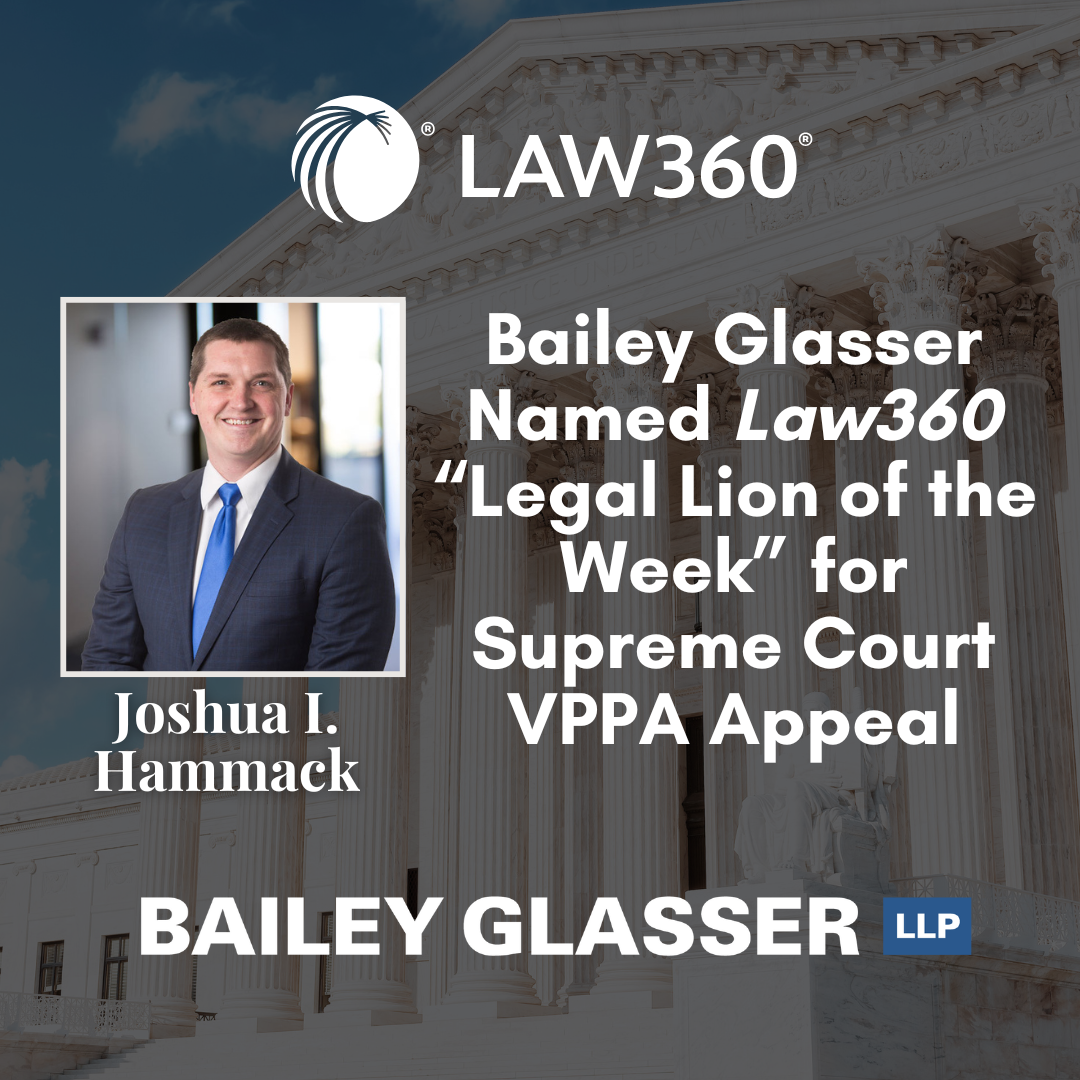
Bailey & Glasser, LLP, has been named a Law360 “Legal Lion of the Week” for the appellate work spearheaded by partner Joshua I. Hammack. Last week, the Supreme Court granted certiorari in Salazar v. Paramount Global, a hotly litigated case about the meaning of “consumer” under the Video Privacy Protection Act (VPPA).
As described by Law360:
Bailey & Glasser LLP roared after the U.S. Supreme Court agreed on Monday to consider what criteria consumers must meet to sue under the federal Video Privacy Protection Act, accepting a challenge to a ruling that said a Paramount digital newsletter subscriber could not bring a lawsuit. The justices granted Michael Salazar’s petition for a writ of certiorari asking the high court to determine whether the VPPA applies to consumers who subscribe to nonaudiovisual content, such as a digital newsletter. In a proposed class action, Salazar, who subscribed to a digital newsletter from Paramount Global’s 24/7 Sports, alleged illegal sharing of subscribers’ personal information with Facebook. Salazar is represented by Joshua Hammack of Bailey & Glasser.
To read the full Law360 article visit this link.
Partner Joshua I. Hammack led the appellate team, with valuable assistance from Michael L. Murphy, Nicholas S. Johnson, Allison A. Bruff, and Hallie H. Arena, as well as paralegal support from Manny Rios. The matter will now proceed to merits briefing and argument before the Supreme Court.
The VPPA was enacted in 1988, shortly after a local D.C. video store disclosed the rental records of Judge Robert Bork—who was then under consideration for a seat on the Supreme Court—to a journalist. The law broadly prohibits a video tape service provider from knowingly disclosing a consumer’s personally identifiable information without first obtaining that consumer’s consent. As most relevant here, the VPPA defines “consumer” to include a “subscriber of goods or services from a video tape service provider.” In this case, Paramount disclosed Mr. Salazar’s Facebook ID (a unique numerical identifier Facebook assigns to each user) and video-watching history to Facebook without his consent. Mr. Salazar sued, alleging Paramount’s conduct violated the VPPA. But both lower courts held Mr. Salazar was not a statutory “consumer” because he subscribed only to Paramount’s online newsletter, and not to its audiovisual goods or services. As a result, both lower courts dismissed his VPPA claim. Now the Supreme Court will decide the question.
This case will have significant implications for how streaming services and other platforms handle user data. And it will almost certainly affect the privacy rights of millions of American consumers.
Learn more about the case and appeal here.