
Bailey Glasser ERISA Litigators Defeat Motion to Dismiss ESOP Case Against Members of Privacy Equity Firm
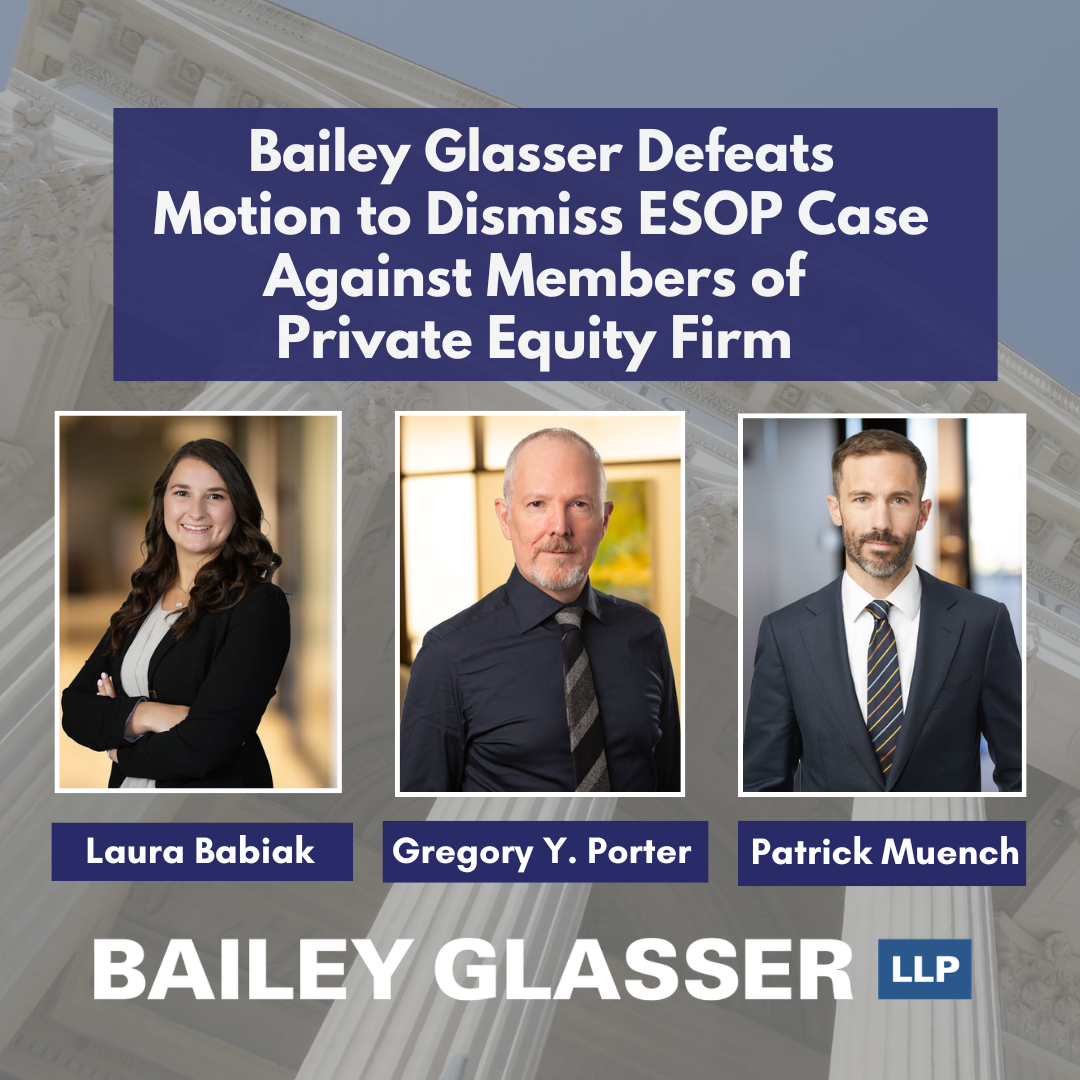
Bailey Glasser’s ERISA Practice Group, along with co-counsel Nichols Kaster, recently defeated a Motion to Dismiss filed by company directors who also worked for the private equity firm that sold the company to the ESOP. The court’s decision made clear that principals at private equity firms cannot hide behind corporate formalities to avoid liability as ERISA fiduciaries when they orchestrate the sale of a company to an ESOP at far above fair market value.
The Bailey Glasser litigation team includes Gregory Porter, the group’s Practice Group Leader; partner Patrick Muench; and lawyer Laura Babiak.
This lawsuit was filed in 2022 by plaintiff Paul Laidig, along with other current and former employees of Vi-Jon, a company that manufactures personal care products, including hand sanitizer. The plaintiffs hold shares in the company through the Vi-Jon Employee Stock Ownership Plan (“ESOP”). Through a complicated set of transactions that began during COVID, the defendants caused the ESOP to purchase the company based on unrealistic projections, including that hand sanitizer sales, which peaked early during COVID, would not see a return to normal sales growth. Essentially, they foisted the company on the employees assuming close to peak COVID sales into perpetuity.
We allege that the defendants caused the ESOP to engage in a prohibited transaction in violation of Employee Retirement Income Security Act, 29 U.S.C. § 1001, et seq. (“ERISA”). Specifically, we allege that defendants orchestrated the ESOP transaction at an artificially inflated purchase price by capitalizing on overly optimistic performance expectations due to the temporary surge in demand for hand sanitizer during the COVID-19 pandemic, all because Berkshire had been unable to unload its stake in Vi-Jon for a high-enough price to exceed Berkshire’s compensation hurdle—i.e., the threshold rate at which managers and general partner entities receive a share of profits. We assert that the inflated price resulted in an unsustainable debt-load, which, in turn, has put Plaintiffs’ retirement benefits in jeopardy and caused pressure from lenders on management to make decisions that compromise the company’s value and long-term viability, among other things.
The Motion to Dismiss addressed, in part, individual director-defendants’ motions to dismiss, alleging that they were not fiduciaries and also did not have sufficient knowledge related to the ESOP transaction at issue. The United States District Court for the Northern District of Illinois disagreed, finding that the plaintiffs sufficiently alleged required fiduciary and legal duties. Indeed, related to individual defendants who sought to be dismissed from the case: “[t]rue, only the board of VJ Holding Corp. may have expressly approved GreatBanc’s engagement as trustee, but Plaintiffs allege that New Defendants all exercised control with respect to the ESOP transaction to a certain extent, by, for example, setting the transaction in motion, causing the selection of GreatBanc, monitoring and interacting with GreatBanc, and approving the transaction. Although a defendant’s mere status as a director or officer of a company does not necessarily make them a fiduciary, a defendant’s or group of defendants’ ability to control the appointment and approval of a trustee through their positions may support a reasonable inference regarding fiduciary status.”
This decision is especially important because it provides accountability for principals at private equity firms who may be personally liable for their conduct in orchestrating ESOP transactions.
The case will now proceed to discovery. To read the decision and learn more, visit this link.